
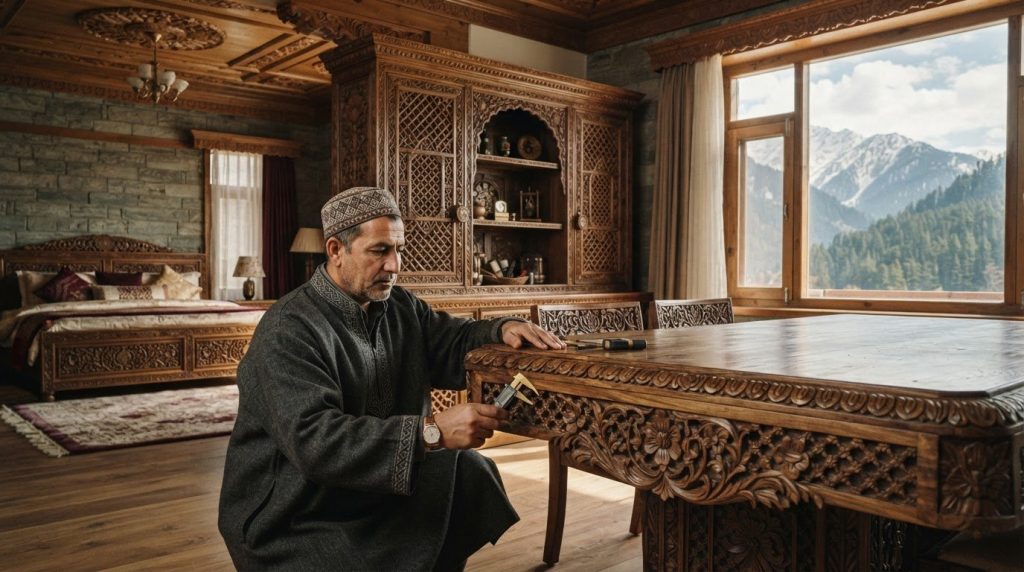
What if the intricate carving across that statement table hides unseasoned timber destined to warp once exposed to your home’s heating? Investing in authentic walnut wood furniture Kashmir is celebrated for requires clear quality standards rather than guesswork. Between machine-stamped imitations and unseasoned branch cuts entering the market, finding reliable heirloom construction demands a methodical approach.
You expect a statement piece to last for generations, yet conflicting timber grades and vague sourcing claims make it difficult to purchase with confidence. That caution is justified. This guide provides practical steps to evaluate wood density, verify genuine artisan chiseling, and select or commission custom-made furniture built to withstand modern indoor environments.
Ahead, you’ll learn how to distinguish dense root wood from standard trunk timber, identify regional craftsmanship markers, and source dependable indoor furniture tailored to your exact floor plan.
Key Takeaways
- Differentiate between dense root cuts and standard trunk timber to select the ideal grain pattern and structural strength for your space.
- Identify genuine hand-chiseled relief work across undercut, deep, and lattice styles to avoid machine-pressed imitations.
- Apply moisture and seasoning verification checks to ensure your walnut wood furniture Kashmir investment remains stable over decades.
- Balance intricate carved motifs with clean contemporary interior layouts through practical spatial scaling.
- Streamline bespoke commissioning by preparing precise floor plan measurements and timber specifications for regional manufacturers.
Understanding Kashmiri Walnut Wood: Origins, Characteristics, and Timber Grades
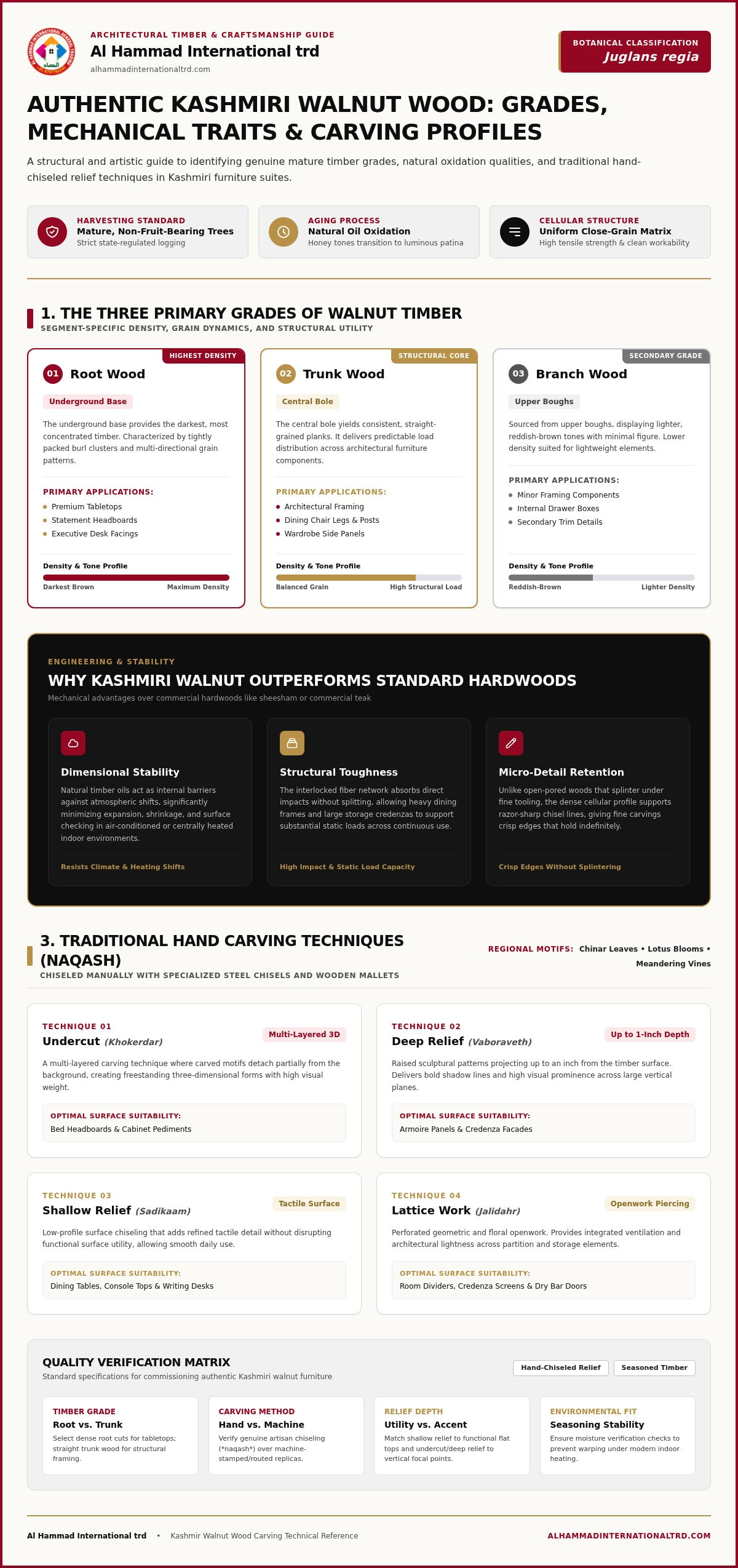
Kashmiri walnut wood (Juglans regia) serves as the primary material for heavy architectural furniture suites, distinguishing full room layouts from lightweight decorative trinkets. The timber features an exceptionally close, uniform cellular structure that balances high tensile strength with clean workability. As the wood matures, natural oils within the fibers oxidize, transitioning lighter honey tones into deep, luminous brown patinas over decades. Established under strict state harvesting regulations and protected under Kashmir walnut wood carving classifications, logs are cut exclusively from mature, non-fruit-bearing trees to yield specific material grades.
The Three Primary Grades of Walnut Timber
Timber selection dictates the structural stability, surface density, and visual depth of walnut wood furniture Kashmir craftsmen build. Logging yields three distinct segments:
- Root Wood: The underground base provides the darkest, most concentrated timber. Characterized by tightly packed burl clusters and multi-directional grain patterns, this dense cut is reserved for premium tabletops, headboards, and executive desk facings.
- Trunk Wood: The central bole yields consistent, straight-grained planks. It provides predictable load distribution, making it the standard choice for architectural framing, dining chair legs, structural posts, and wardrobe side panels.
- Branch Wood: Sourced from upper boughs, this cut displays lighter, reddish-brown tones with minimal figure. Its lower density makes it suitable for minor framing components, internal drawer boxes, and secondary trim.
Why Kashmir Walnut Outperforms Standard Hardwoods
Kashmiri walnut delivers structural and mechanical benefits that outperform common industrial hardwoods like sheesham or commercial teak:
- Dimensional Stability: Natural timber oils act as internal barriers against atmospheric shifts, significantly minimizing expansion, shrinkage, and surface checking in air-conditioned or centrally heated indoor environments.
- Structural Toughness: The interlocked fiber network absorbs direct impacts without splitting, allowing large dining frames and storage credenzas to support heavy static loads across continuous commercial or residential use.
- Micro-Detail Retention: Unlike open-pored woods that splinter under precise cutting, the dense cellular profile supports razor-sharp chisel lines, giving fine carvings crisp edges that hold their shape indefinitely across premium walnut wood furniture Kashmir suites.
Traditional Kashmiri Carving Techniques and Decorative Motifs
Carving depth dictates both the visual weight and the daily utility of large-scale furnishings. Master artisans, historically known as naqash, execute relief work manually with specialized steel chisels and wooden mallets. Regional motifs draw heavily from indigenous flora, incorporating chinar leaves, lotus blooms, and meandering vine patterns. Modern interior layouts pair these ornamental details with flat, clean planes, ensuring dining tables and credenzas remain practical. Studying registered traditional carving techniques helps buyers identify how heritage craftsmanship adapts to full-sized architectural suites.
Recognizing the Four Core Carving Styles
Kashmiri artisans classify their chiseling across four distinct depth profiles, each suited to different furniture surfaces:
- Undercut (Khokerdar): A multi-layered technique where carved motifs detach partially from the background, creating freestanding three-dimensional forms. Ideal for bed headboards and cabinet pediments.
- Deep Relief (Vaboraveth): Raised patterns projecting up to an inch from the timber surface. Delivers bold shadow lines across armoire panels and credenza facades.
- Shallow Relief (Sadikaam): Low-profile carving that adds tactile detail without disrupting surface utility. Perfect for dining tables, console tops, and writing desks.
- Lattice Work (Jalidahr): Perforated geometric and floral openwork. Provides ventilation and visual lightness for room dividers, credenza screens, and dry bar doors.
Authentic Hand Carving versus Machine Stamping
Rising commercial demand has led to machine-routed replicas entering the market, making inspection critical when selecting authentic walnut wood furniture Kashmir suppliers provide. Genuine hand carving displays slight, organic variations in stroke depth, cut angles, and undercut clearances. Tool marks reflect the rhythmic impact of a mallet against the grain, yielding sharp inner corners that industrial router bits can’t replicate.
Machine-routed alternatives rely on rotating CNC drill bits that leave uniform, radiused interior corners and burn marks along dense fibers. In stamped decor, motifs often look identical and sit atop synthetic pastes glued to particle boards. Authentic furniture shows unbroken timber grain passing through both the carved relief and the structural frame. If you need traditional motifs fitted to contemporary architectural dimensions, commissioning custom made furniture ensures certified solid timber joinery carved by experienced regional artisans.
Evaluating Quality: The Essential Walnut Furniture Buying Framework
Assessing solid wood furnishings requires looking past surface ornamentation to evaluate structural integrity and raw material readiness. Unlike smaller craft pieces, architectural room suites bear continuous mechanical loads and experience room-wide temperature swings. Knowing how to inspect timber preparation, structural joinery, and protective coatings ensures your investment remains structurally sound for generations.
Moisture Content and Seasoning Standards
Proper timber seasoning forms the bedrock of durable construction. Freshly cut walnut holds substantial internal moisture that must be systematically extracted before a chisel touches the board. Reliable manufacturers rely on multi-year open-air drying to stabilize the cell walls, followed by controlled kiln cycles to bring the moisture content down to a uniform 8 to 12 percent.
Skipping this process causes unseasoned timber to warp, twist, and develop deep checks as indoor climates shift between seasons. Review our indoor furniture guide for local climate resilience strategies that keep natural wood stable through severe seasonal temperature swings.
Joinery and Structural Construction Quality
Heirloom-grade furniture relies on mechanical wood-to-wood joinery rather than fast commercial fixes. Inspect every major structural junction across the piece:
- Interlocking Joints: Mortise-and-tenon and dovetail assemblies distribute structural stress across wide timber surfaces, preventing wobbling in bed frames, consoles, and dining tables.
- Corner Blocking: Heavy load points on seating and cabinetry require screwed and glued solid wood corner braces to stop lateral racking.
- Solid Drawer Construction: Quality walnut wood furniture Kashmir makers produce features solid hardwood drawer boxes with interlocking dovetails instead of thin, stapled composite bases.
- Fastener Restraint: Avoid pieces held together entirely by visible drywall screws or industrial contact adhesives, which sheer under load as timber naturally breathes.
Surface Finishes: Natural Wax versus Chemical Varnishes
The applied finish significantly impacts how the wood ages, breathes, and responds to routine maintenance. Traditional Kashmiri finishing involves agate stone burnishing followed by repeated applications of heated beeswax. This technique seals the wood pores while leaving the natural grain tactile and luminous.
Heavy polyurethane coats or thick synthetic varnishes trap timber moisture, create an artificial plastic glare, and crack when the wood flexes. Natural wax and satin oil treatments allow the walnut to develop its signature antique patina naturally. These traditional finishes simplify spot repairs, letting you buff out light scuffs with a fresh wax rub rather than requiring a complete chemical strip.
Walnut Furniture for Modern Spaces: Room-by-Room Guide
Integrating heavy timber into contemporary floor plans requires intentional balance. Dense, dark-grained wood commands visual attention and can overwhelm compact rooms if proportions aren’t calculated early. Follow four core steps to achieve balance across your layout:
- Establish Spatial Scale: Limit full suites to larger rooms, or use a single carved statement piece to anchor smaller rooms.
- Prioritize Flat Work Surfaces: Reserve deep relief carving for vertical panels and structural frames to keep tabletops practical.
- Pair with Clean Upholstery: Contrast dark carved timber against crisp, light-toned textiles such as cream linen or tailored wool.
- Unify Wood Tones: Align the warm undertones of walnut with your surrounding flooring, architectural trim, and door casings.
Living and Lounge Environments
Walnut coffee tables featuring shallow relief carving anchor living rooms without compromising beverage stability. Accent armchairs add sculptural presence when upholstered in neutral performance fabrics, balancing intricate woodwork with minimalist seating. Media consoles built with openwork lattice (jali) door panels conceal audio-visual components while providing ventilation and allowing infrared signals to reach entertainment devices.
Dining and Entertaining Collections
Dining rooms demand hardwearing surfaces that withstand daily use. An ideal Kashmiri dining table features a smooth, stone-polished center board framed by a delicately carved apron and legs. Review our dining room furniture guide for exact spatial planning tips, clearance ratios, and chair spacing standards. Pair the table with a solid walnut sideboard credenza to secure dinnerware, linens, and entertaining accessories behind deep-relief panel doors.
Bedrooms and Private Suites
Bedrooms benefit from the grounding visual weight of solid wood. An undercut or deep-relief headboard transforms the master bed into an architectural focal point. Complement the bed frame with matching nightstands engineered with smooth top decks and carved drawer faces. For comprehensive storage, custom wardrobes combine solid walnut frame posts with customized internal shelving and drawer boxes. Explore indoor furniture options to configure complete suites scaled precisely to your floor plan.
Bespoke Commissioning, Maintenance, and Preservation in Jammu and Kashmir
Standard catalogue dimensions rarely align with specific room proportions or custom architectural floor plans. Custom manufacturing enables homeowners and commercial designers to tailor traditional relief carving to exact spatial layouts. Operating locally, Al Hammad International trd delivers custom-made furniture built to precise dimensions, structural specifications, and functional needs. Pairing regional woodcraft with personalized layouts guarantees that every console, dining set, or wardrobe integrates cleanly into your interior.
Commissioning Bespoke Walnut Wood Furniture
Commissioning bespoke walnut wood furniture Kashmir workshops manufacture begins with a comprehensive technical brief. Establishing exact room clearances, weight capacities, and desired timber cuts early eliminates fabrication delays. Specifying dense root wood for focal surfaces while reserving straight trunk cuts for load-bearing framing balances visual depth against material weight. Review our custom made furniture guide for step-by-step commissioning procedures, dimension mapping, and artisan collaboration advice.
Routine Cleaning and Carving Maintenance
Intricate carving styles gather airborne particles that dull timber finishes if neglected. Maintain your pieces using a consistent care routine:
- Crevice Dusting: Clear undercut hollows and lattice piercings weekly using a soft, natural bristle brush to sweep away dust without scratching delicate facets.
- Grain Wiping: Clean smooth surfaces with a lint-free microfiber cloth, barely dampened with water, moving strictly in the direction of the wood grain.
- Beeswax Nourishment: Buff high-grade natural beeswax across the timber twice yearly. This seals the pore network and protects the wood against parched interior air.
Environmental and Placement Considerations
Solid walnut responds continuously to ambient moisture swings. Position finished pieces at least two meters away from direct heat radiators, electric blowers, and active fireplaces to prevent localized timber shrinkage. Shield surfaces from continuous, direct sunlight, which bleaches rich natural brown tones unevenly over time. During dry, sub-zero winter months, operate an indoor humidifier to maintain ambient relative humidity between 40 and 60 percent, preventing joint fatigue and surface checking.
Securing Authentic Kashmiri Craftsmanship for Modern Living
Selecting verified timber cuts, confirming proper moisture seasoning below 12 percent, and distinguishing genuine hand-chiseled relief from machine routing protect your long-term investment. These quality benchmarks ensure your walnut wood furniture Kashmir acquisition remains structurally stable over decades while anchoring your home with distinct architectural presence.
Partnering with regional specialists eliminates the guesswork from sourcing bespoke dimensions and authentic finishes. Operating directly within Jammu and Kashmir, Al Hammad International trd provides streamlined regional access to master woodworkers. We support residential and commercial environments with dedicated custom-made furniture capabilities, pairing heritage carving styles with modern layouts across our comprehensive indoor and outdoor furniture portfolios.
Equip your interior with durable pieces built to withstand shifting seasons and continuous daily use. Explore custom furniture solutions to begin commissioning authentic, made-to-order woodwork tailored to your exact design specifications.
Frequently Asked Questions
How can I tell if walnut wood furniture from Kashmir is genuinely authentic?
Look for official QR code-enabled Geographical Indication (GI) labels and examine carving tool marks. Authentic hand-carved pieces show subtle cut depth variations and sharp interior chisel lines rather than the rounded edges typical of CNC routers. The grain should run continuously across both flat panels and carved relief. Sourcing verified walnut wood furniture Kashmir suppliers produce guarantees the piece uses seasoned Juglans regia timber rather than stained substitute woods.
Is Kashmiri walnut wood durable enough for everyday dining and living room use?
Yes, properly cured Kashmiri walnut delivers superior dimensional stability and shock resistance for daily residential wear. Its dense cellular structure absorbs continuous mechanical stress without cracking or denting easily. For functional high-traffic surfaces like dining tables, opt for designs featuring smooth central boards paired with carved border aprons. This keeps tabletops flat for dinnerware while preserving the rich, long-lasting aesthetic of solid timber framing.
Why does root wood walnut cost more than trunk or branch wood?
Root wood commands higher value due to its extreme density, rare burl patterns, and the intensive labor required to harvest it. Located entirely below the soil line, root timber requires careful excavation to avoid fiber damage. Its interlocking grain structure creates dramatic dark marbling that can’t be duplicated. Because root sections represent only a small fraction of usable timber per tree, availability remains limited.
How do I clean and dust intricate deep-relief hand carvings without damaging them?
Dust carved crevices gently using a dry, soft-bristle natural horsehair brush or a specialized makeup brush. Avoid stiff synthetic brushes, vacuum nozzles, or aerosol furniture polishes that leave sticky chemical residues inside undercut pockets. For flat timber borders, wipe along the grain with a barely damp microfiber cloth. Apply pure beeswax sparingly twice a year to nourish the wood fibers and protect deep relief work against indoor dryness.
Can traditional Kashmiri walnut carving styles be integrated into minimalist modern homes?
Yes, combining intricate carving with understated modern interiors creates balanced, compelling spaces. Use a single carved credenza, lattice screen, or statement headboard as an architectural focal point rather than filling a room with matching heavy suites. Pair the dark timber with light, neutral upholstery fabrics like ivory linen, and keep surrounding walls simple. This contrast highlights the artisan craftsmanship without visually crowding contemporary layouts.
Does solid walnut furniture require climate control or special room conditions in winter?
Solid walnut thrives best when room humidity stays between 40 and 60 percent, especially during cold sub-zero winters. Heating blowers and direct radiators dry out timber quickly, which can induce joint stress or hairline surface checks. Run a room humidifier in heated spaces and place furniture at least two meters away from heat vents. These basic precautions prevent unseasonable contraction across your indoor furniture collections.
Can I order custom-made walnut furniture tailored to specific room dimensions?
Yes, custom commissioning allows you to adapt traditional motifs and timber grades to non-standard room layouts. Al Hammad International trd provides dedicated custom-made furniture manufacturing across Jammu and Kashmir for residential and commercial spaces. You supply floor dimensions, timber cut preferences, and storage configurations, and local artisans produce tailored pieces that fit modern interiors while honoring authentic regional woodworking traditions.