
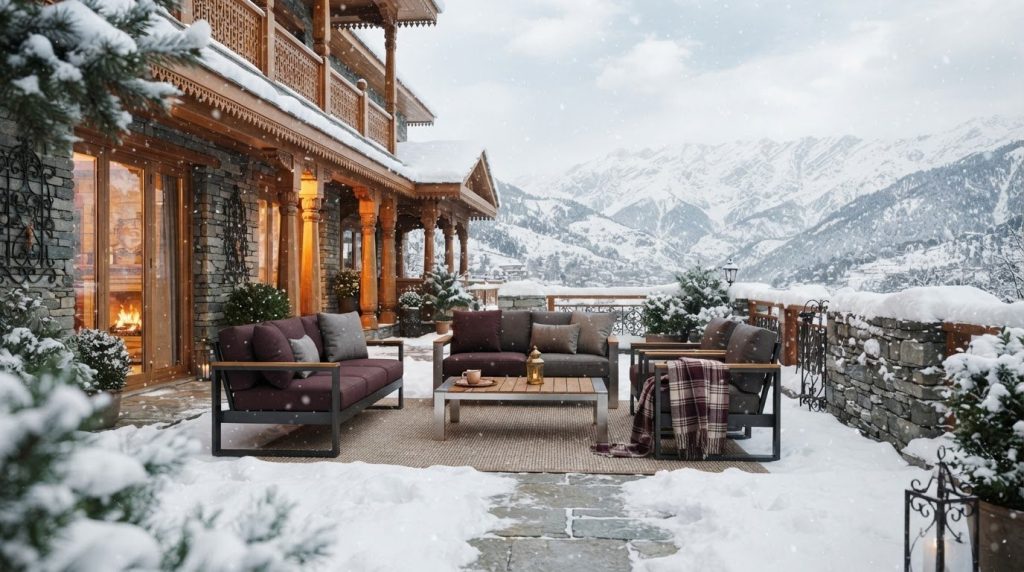
The strongest-looking material isn’t automatically the safest choice for a snowy terrace. Durable outdoor furniture for heavy snowfall depends on the complete setup: materials, joints, frame design, exposure to wind and moisture, and winter care. In Jammu and Kashmir, a sheltered balcony may need a different approach from an open garden or a site where snow drifts around furniture.
It’s reasonable to worry about cold, moisture, and snow damaging furniture left outdoors, especially when product descriptions make broad claims without construction details. This guide compares materials such as aluminium, teak, HDPE, and stainless steel, and explains which specifications to verify before buying. You’ll also find practical guidance on covering, storing, and checking furniture through winter. When discussing outdoor furniture or custom-made options with a supplier, use these questions to clarify available materials, construction, and manufacturer care instructions.
Key Takeaways
- Choose durable outdoor furniture for heavy snowfall by assessing the complete product and the conditions at your site, not just its material label.
- Compare wood, metal, and synthetic options based on moisture exposure, maintenance, comfort, and available storage space.
- Check frame design, joints, and fasteners, and ask for written manufacturer guidance before assuming furniture can support accumulated snow.
- Use a seasonal care routine and follow product-specific instructions for cleaning, covering, snow removal, and storage.
- Ask suppliers which materials and construction details are available, and whether a custom-made option can suit your site.
What heavy snowfall means for outdoor furniture in Jammu and Kashmir
Durable outdoor furniture is furniture whose materials, construction, and care suit the conditions at its actual location. A sheltered balcony and an open garden can experience different combinations of snow, meltwater, wind, and dampness. Conditions also vary across Jammu and Kashmir, so a regional label alone can’t tell you what a particular furniture set will face.
Snow accumulation is only one part of winter exposure. Meltwater can pool on surfaces or around joints, and repeated freezing and thawing may put stress on finishes and connections. Wind can blow snow into sheltered corners or shift it around exposed furniture. A material label alone cannot establish whether furniture is suitable for snow. Assess the product alongside its location, then check the manufacturer’s guidance for that specific item instead of assuming a universal snow limit.
Materials commonly used for outdoor furniture include wood, metal, and plastic, as outlined in this overview of common materials used for outdoor furniture. That list is a starting point, not proof that a particular item will tolerate snow or prolonged moisture. Construction, finish, drainage, and winter care matter too.
How snow, meltwater, and winter exposure affect outdoor furniture
Moisture that stays trapped or pooled can affect finishes and surfaces over time, so check joints and fasteners as well. Cushions and other fabric parts may remain wet longer than exposed frames and may need separate storage. Wind exposure matters too: drifting snow can collect around furniture even where nearby areas look clear. Before buying, ask for written guidance on snow exposure, snow removal, cleaning, and storage.
Assess your Jammu and Kashmir site before comparing furniture
Record the conditions where each piece will sit rather than relying only on descriptions such as “Kashmir winter” or “snow region.” Note the site’s elevation, nearby shelter, wind exposure, drainage, and access to winter sunlight. Consider where snow and meltwater collect and whether water drains away or lingers around the furniture.
A covered balcony or veranda may reduce direct snowfall but can still be exposed to wind-blown snow and dampness. A patio may have less shelter, while an open garden may be affected by drifting snow. These are factors to assess at your site, not fixed rules. Share your observations with the supplier when comparing options, including custom-made furniture. Ask which materials and constructions are available and whether the manufacturer’s documents address the conditions you’ve noted.
Compare outdoor furniture materials for snowy conditions in Jammu and Kashmir
Material categories can help narrow your search, but they don’t prove that a particular piece suits winter exposure. Compare the full specification: material grade, fabrication, coatings, joints, and manufacturer care instructions. This matters when choosing durable outdoor furniture for heavy snowfall, because moisture and cold may affect different parts of a set in different ways.
| Material category | Moisture and finish | Weight and comfort | Winter storage |
|---|---|---|---|
| Wood | Performance depends on species, treatment, finish, drainage, and maintenance. Ask how often the finish needs attention. | Weight varies by wood and construction. Comfort may depend on cushions or shaped surfaces. | Follow the maker’s advice on covering or storing it, and keep cushions dry. |
| Metal | Alloy and corrosion protection matter. Ask how to care for the finish and what to do if it is scratched or chipped. | Weight varies by design and material. Check whether the piece is practical to move or secure at your site. | Confirm whether it can remain outdoors and how to prevent moisture from lingering around joints. |
| Synthetic | Outdoor suitability and cold-weather care depend on the specific material and product instructions. | Weight and seating comfort vary. Check the frame and any woven or moulded components. | Ask whether the furniture and its cushions should be covered, moved, or stored indoors. |
Wood and metal: what specifications matter more than the label
For wood, ask for the species, any treatment, the finish, how water drains from surfaces, and the recommended winter maintenance. Don’t assume a familiar wood name guarantees snow performance. For metal, ask which alloy is used, how it’s protected against corrosion, how the joints are made, and how to care for damaged surface protection. A label such as “metal” or “wood” is not a complete specification.
Synthetic furniture, cushions, and mixed-material designs
Ask whether synthetic parts are intended for outdoor use and whether cold weather changes their cleaning or storage instructions. For cushions, check the fabric, whether covers can be removed, how the pieces should be dried, and where they should be stored in winter. With mixed-material furniture, inspect every component and connection, not only the visible frame.
Al Hammad International trd sells outdoor furniture. When comparing options, ask which materials, models, and finishes are currently available and whether the manufacturer provides guidance for winter exposure. You can explore outdoor furniture from Al Hammad International trd and discuss the specifications that matter for your site. Custom-made furniture is also available to discuss. Confirm the scope and whether outdoor-specific requirements can be considered.
How frame strength, joints, and design affect snow durability
Material is only one part of a furniture set’s performance. Frame geometry, bracing, joints, fasteners, and assembly all affect how it holds together in outdoor use. Descriptions such as “strong frame” or “heavy-duty construction” are not a verified snow-load rating. For durable outdoor furniture for heavy snowfall, ask for documentation about the exact product rather than relying on promotional wording.
What to inspect in frames, joints, and fasteners
Look at how frame parts connect and whether the joints appear secure and consistently assembled. Ask whether the fasteners are intended for outdoor exposure, whether parts can be replaced, and what inspection or maintenance the manufacturer recommends. Check that the furniture sits steadily on the surface where you plan to use it, and look for areas where water could collect. These checks help you assess a product, but they don’t establish its snow-load capacity.
Design can affect how snow settles. Open forms may allow snow to pass through, while broad horizontal surfaces, deep seats, or cushions may retain it. Neither shape guarantees a particular result: wind, drifting, and the site can change where snow accumulates. Follow the manufacturer’s snow-clearing instructions instead of assuming the frame can carry a buildup.
Snow-load claims and product documentation to request
Ask whether the manufacturer provides a stated snow-load rating for the exact model. If so, request the written limit, test conditions, and instructions for clearing accumulated snow. Confirm that the documents apply to the complete piece, including its frame and assembly, rather than to a similar-looking product or a material in general.
If the manufacturer doesn’t provide snow-load documentation, don’t describe the furniture as rated for heavy snow. Ask what exposure and care guidance is available, then make your decision with that limitation in mind.
For custom-made furniture, confirm the construction details, intended outdoor use, and written care guidance before ordering. Ask what frame design, bracing, joints, and fasteners are specified, and whether the manufacturer can provide snow-exposure instructions. Al Hammad International trd offers custom-made furniture. Check the available scope and documentation for any option you’re considering.
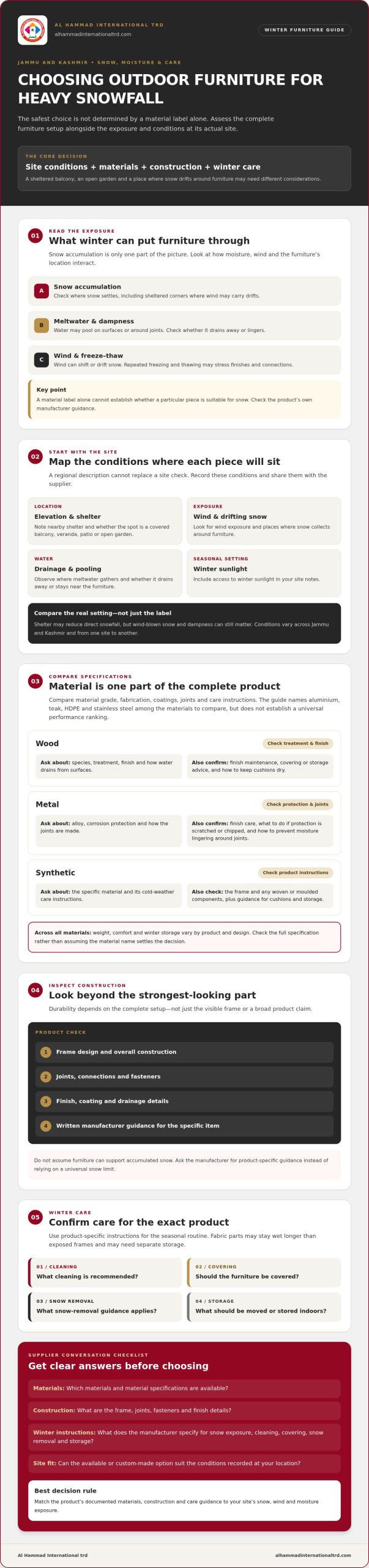
A practical winter-care plan for outdoor furniture in Jammu and Kashmir
Winter care should match the furniture and its location. A covered veranda may need a different routine from an open garden exposed to drifting snow, and access can affect whether you can inspect or move furniture after snowfall. Follow the manufacturer’s instructions for cleaning, covers, snow removal, and storage. A general routine is useful, but it doesn’t replace product-specific guidance for durable outdoor furniture for heavy snowfall.
Before winter: prepare furniture for the site
Before winter, check the care instructions and identify which parts need to be moved or protected. Clean and dry each item as directed before covering or storing it. Check drainage around the furniture, consider whether the location is exposed to drifting snow, and confirm that any cover fits the product without trapping moisture. Store cushions and detachable components in a dry place if the manufacturer recommends it.
After snowfall: inspect and follow product-specific care
Inspect the furniture when conditions allow. Look for standing water, movement from its original position, loose fasteners, finish damage, and dampness beneath covers or cushions. Don’t use a tool or apply force to remove snow unless the manufacturer approves that method. Note recurring problems, such as water collecting around the legs, to help guide next season’s care or furniture choices.
- Prepare: Clean and dry furniture according to its care instructions. Check joints, drainage, and removable parts.
- Protect or store: Use a suitable, correctly fitted cover, or move the furniture indoors if the maker recommends it. Don’t assume plastic wrapping or a tight cover is appropriate.
- Inspect after snowfall: Check for water, shifted furniture, visible damage, or moisture beneath covers. Follow product-specific guidance before clearing snow.
- Dry: When conditions permit, let wet surfaces and removable components dry as directed. Avoid covering damp furniture unless the instructions allow it.
- Check again in spring: Review finishes, joints, fasteners, and cushions. Record recurring issues and adjust the storage or placement plan for the next winter.
Adapt the routine to local exposure and practical access. If furniture is difficult to reach during snowfall, plan protection and storage before winter rather than relying on frequent checks. For additional background, see this weather-resistant outdoor furniture durability guide.
To compare options for your site, discuss your outdoor furniture requirements and ask which current products come with manufacturer guidance for winter care, covering, and storage.
Choose a snow-conscious outdoor furniture option with a clear buying checklist
A sound purchase decision starts with information about the exact product and the conditions at your site. For durable outdoor furniture for heavy snowfall, compare written specifications and care instructions instead of relying on broad claims such as “all-weather” or “heavy-duty.” If important details are missing, ask the supplier to clarify them before deciding.
Questions to ask before buying outdoor furniture for heavy snowfall
- Site exposure: What should you share about the location, including shelter, wind, drainage, and likely snow drifting?
- Materials and finishes: Which materials, finishes, cushions, and other components are confirmed for this specific model?
- Frame construction: How is the frame assembled, and what information is available about its joints and fasteners?
- Snow guidance: Does the manufacturer provide written snow-load guidance for the exact product? If so, ask for the stated limits and conditions.
- Winter care: What cleaning, covering, snow removal, and storage methods does the manufacturer recommend?
- Practical details: Confirm assembly requirements, cover fit, cushion storage, and routine maintenance before comparing options.
Keep the answers with the product details. Comparing options against the same criteria makes it easier to spot where information is incomplete. For broader selection advice, see the outdoor garden furniture buying guide and the luxury outdoor furniture guide.
When to discuss a custom-made furniture option
Custom dimensions may help a piece fit a balcony, veranda, or patio, but they don’t establish snow performance. Ask whether outdoor materials and construction can be specified, what documentation is available for winter exposure, and which care instructions will apply. Confirm the maker’s scope before assuming a requested feature is available.
Al Hammad International trd offers outdoor furniture and custom-made furniture. Ask which options are currently available, what construction details can be provided, and whether manufacturer documentation covers winter exposure. Share your location, site conditions, and requirements when discussing a suitable option.
Make your next outdoor furniture choice with confidence
Choosing durable outdoor furniture for heavy snowfall means looking beyond material labels. Match the furniture to the exposure at your specific site, then compare its frame, joints, finishes, and written manufacturer guidance. A clear winter-care plan matters too, particularly for cushions, covers, snow removal, and storage.
Before buying, get product-specific details in writing and clarify anything that’s missing. Broad claims about strength or weather resistance aren’t a substitute for snow-load information or care instructions. The right choice is one whose documented features and maintenance needs fit your location and routine.
Al Hammad International trd offers outdoor furniture and custom-made furniture. Ask which materials and constructions are currently available, whether manufacturer guidance can be provided, and whether outdoor-specific requirements can be discussed for a custom-made option. Discuss outdoor furniture options with Al Hammad International trd, and share your site conditions and questions.
With clear specifications and realistic winter care, you can make a more informed choice for your outdoor space.
Frequently Asked Questions
Can outdoor furniture be left outside during heavy snowfall?
Some outdoor furniture may be left outside, but only if the manufacturer’s instructions support that use and you can follow its winter-care guidance. Suitability depends on the exact product and site, including shelter, wind, drifting snow, and drainage. Don’t infer snow tolerance from a general “outdoor” label. For durable outdoor furniture for heavy snowfall, check written snow-exposure guidance and whether the maker advises covering, storing, or clearing the item.
Which outdoor furniture material is best for heavy snow?
There isn’t one material that’s best for every snowy site. Performance depends on the specific material grade, finish, frame construction, joints, and maintenance instructions, as well as local exposure in Jammu and Kashmir. Compare documented details rather than choosing by material name alone. Ask what the manufacturer says about moisture, cold-weather care, snow accumulation, and storage for the exact model you’re considering.
How do I protect outdoor furniture from snow and meltwater?
Start with the manufacturer’s instructions for cleaning, drying, covering, storage, and snow removal. Before winter, check drainage and prepare cushions or detachable parts as directed. If you use a cover, confirm that it suits the furniture and won’t trap moisture. After snowfall, inspect for standing water, dampness, movement, or visible damage. Use only manufacturer-approved methods to clear snow, since products may have different care requirements.
Should I cover or store outdoor furniture during winter in Jammu and Kashmir?
Follow the product’s care guidance and consider the exact location. A sheltered balcony or veranda may face different conditions from an exposed patio or open garden, and sites across Jammu and Kashmir aren’t climatically identical. Ask whether the furniture should be covered or moved into dry storage, and how to store cushions. Covers should fit the product and suit its materials. Don’t cover damp furniture unless the manufacturer permits it.
Can snow damage outdoor furniture even if it is made for outdoor use?
Yes. “Made for outdoor use” doesn’t necessarily mean a product is designed to carry snow or withstand prolonged dampness. Snow and meltwater may collect on surfaces, around joints, or beneath cushions and covers. Wind can also cause snow to drift around furniture. Check the manufacturer’s written guidance for the exact model, including exposure limits, care requirements, and snow-clearing instructions, before leaving it outside through winter.
What should I ask a furniture supplier about snow-load ratings?
Ask whether the manufacturer provides a written snow-load rating for the exact model, and request the stated limit, test conditions, and snow-removal instructions. Confirm that any documentation applies to the complete product and its assembly, not just a similar frame or material. Also ask for winter-care directions covering cleaning, covers, cushions, and storage. If no rating is documented, don’t describe the furniture as rated for heavy snow.
Is custom-made outdoor furniture suitable for a snowy site?
It may be an option to discuss, but custom dimensions alone don’t establish suitability for snow. Ask whether outdoor-specific materials and construction can be specified, and whether written manufacturer guidance for winter exposure and care will be available. Al Hammad International offers custom-made furniture and outdoor furniture. Ask about the available scope, construction details, and documentation before making a decision.