
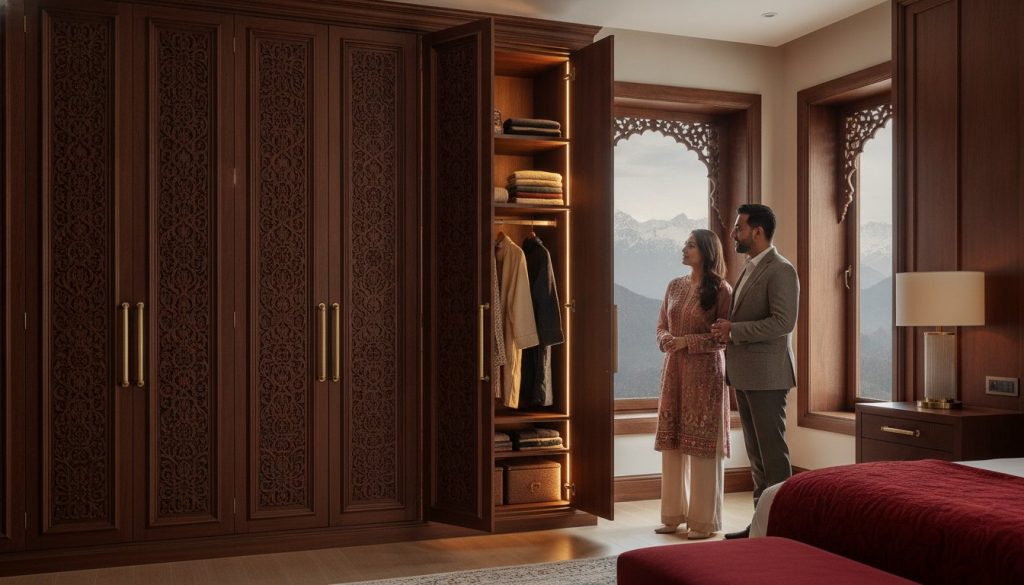
A wardrobe is a structural investment in your property’s efficiency, not just a furniture purchase. You’ve likely seen how ready-made units leave awkward gaps and fail against the specific humidity levels found in Jammu and Kashmir. When standard almirahs succumb to termite damage or poor hardware longevity, the cost of replacement quickly outweighs the initial savings. Building a high-performance custom wardrobe India residents can rely on requires a shift toward technical precision and climate-appropriate material selection.
This guide provides the specifications needed to plan a bespoke storage solution that lasts. We’ll outline how to choose termite-resistant boards and moisture-proof finishes that protect your investment from local environmental stressors. You’ll also learn to optimize internal layouts and utilize floor-to-ceiling heights to eliminate wasted space. From selecting durable hardware to integrating appliances into your cabinetry, this walkthrough ensures your custom furniture delivers professional-grade utility and organized living for years to come.
Key Takeaways
- Understand why bespoke designs offer 100% space utilization compared to the 60% efficiency of standard ready-made units.
- Identify why BWP (Boiling Water Proof) plywood is the mandatory material standard for a high-performance custom wardrobe India residents use to prevent moisture damage.
- Evaluate long-term ROI by calculating the cost per square foot of usable storage rather than focusing solely on upfront purchase prices.
- Master the technical checklist for measuring height, width, and depth while accounting for structural obstructions and storage zones.
- Learn the specific material requirements for furniture durability within the unique residential environments of Jammu and Kashmir.
What is a Custom Wardrobe and Why Choose Bespoke in India?
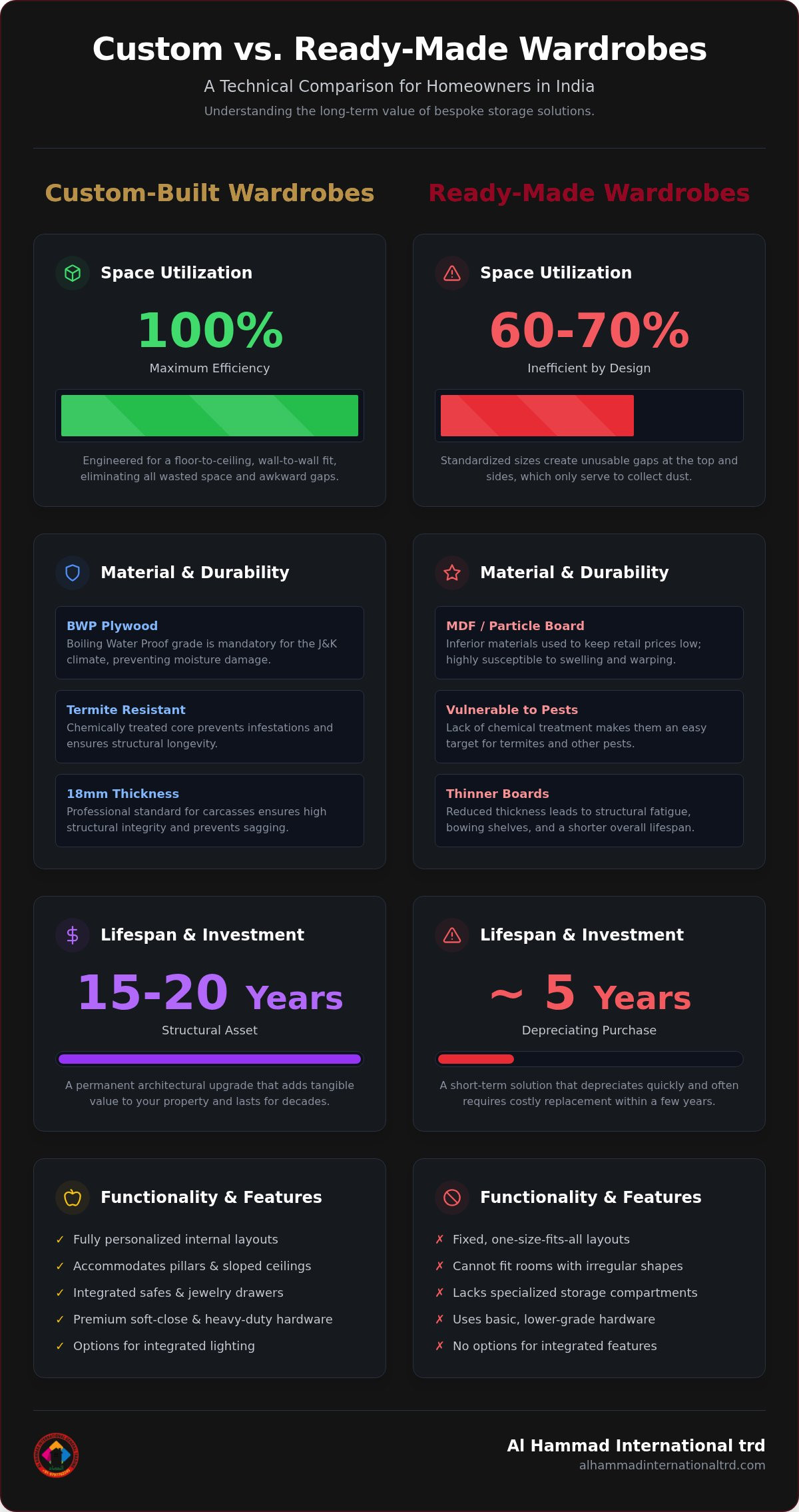
A custom wardrobe is a floor-to-ceiling, wall-to-wall storage solution engineered to fit the exact dimensions of a room. Unlike freestanding furniture, these units integrate into the building’s structure to maximize every available inch. Choosing a custom wardrobe India provides homeowners with 100% space utilization. In contrast, ready-made units typically offer only 60-70% efficiency because they cannot account for specific ceiling heights or wall irregularities. This lost volume represents wasted square footage in homes where space is at a premium.
Homeowners often confuse modular systems with bespoke ones. Modular furniture uses pre-defined cabinet sizes that are assembled on-site. While functional, it lacks the absolute precision of a bespoke build. Bespoke solutions allow for millimeter-perfect adjustments, ensuring no gaps exist between the unit and the ceiling or adjacent walls. This flexibility is vital in modern Indian apartments where floor space is limited and storage needs are high. A custom approach allows you to build around pillars, sloping ceilings, or uneven corners that standard furniture cannot accommodate.
The Limitations of Ready-Made Furniture
Standardized almirahs and retail wardrobes are designed for average spaces, not your specific room. This often results in awkward gaps at the top or sides that serve no purpose other than collecting dust. Mass-produced units frequently rely on inferior materials like MDF or thin particle board to keep retail prices low. These materials struggle in varied climates and often swell or warp over time. Retail options also rarely accommodate specialized storage needs. If you require a hidden safe, dedicated jewelry drawers, or extra-long hanging space for traditional garments, ready-made units usually fall short of these requirements.
Custom Wardrobes as a Real Estate Investment
In Jammu and Kashmir, property value is tied to the quality of permanent fixtures. High-grade indoor furniture that handles local climate stressors adds tangible value to a residence. A professionally built custom unit has a lifespan of 15 to 20 years, whereas retail furniture often requires replacement within 5 years due to structural fatigue. A bespoke wardrobe is a permanent architectural upgrade that transforms a storage requirement into a structural asset. Utilizing Boiling Water Proof (BWP) materials ensures the unit remains a functional part of the home’s inventory for decades without the need for frequent repairs or replacements.
Materials and Mechanics: Building for the J&K Climate
The durability of a custom wardrobe India project depends entirely on the technical grade of its base materials. In Jammu and Kashmir, where temperature fluctuations and seasonal humidity are common, standard commercial boards often fail. Wood warping and structural sagging occur when moisture penetrates the core. Selecting materials based on their environmental resistance is the only way to ensure a long-term return on investment. Professionals prioritize structural stability to prevent the unit from shifting as the building settles or the seasons change.
The Core: BWP Plywood vs. Commercial Board
BWP (Boiling Water Proof) plywood is the mandatory standard for high-performance cabinetry. While many retail units use Boiling Water Resistant (BWR) or commercial MR-grade plywood, these lack the phenolic resin bonding required to withstand prolonged exposure to moisture. BWP plywood can survive immersion in boiling water for 72 hours without delamination, making it ideal for the J&K climate.
- Termite Resistance: Ensure the core is chemically treated during manufacturing to prevent infestations.
- Thickness Standards: A professional carcass requires 18mm thickness for structural integrity. Back panels should be 12mm to prevent bowing.
Hardware and Accessories for Longevity
Mechanical components dictate the daily usability of your furniture. Soft-close hinges prevent door misalignment over time by absorbing the impact of repeated use. For drawers, heavy-duty telescopic slides with a high load-bearing capacity are necessary to handle the weight of heavy winter clothing or stored appliances. Choosing the right mechanism depends on your room’s clearance. Sliding doors save floor space, while hinged doors provide full access to the wardrobe’s interior.
Hardware in humid regions requires anti-corrosive coatings to prevent rust during the monsoon or winter seasons. Integrating motion-sensor LEDs provides visibility in deep storage zones without the need for manual switches. While planning your build, selecting custom made furniture ensures that these technical specifications are prioritized over mass-market cost-cutting measures.
Internal Finishes and Climate Stability
The internal finish protects the plywood core from environmental factors. High-pressure laminates are the most utilitarian choice, offering a scratch-resistant surface that’s easy to clean. Veneers provide a premium aesthetic but require more maintenance and periodic polishing. PU (Polyurethane) paint offers a seamless, moisture-proof barrier that’s highly durable. The application must be airtight to prevent the wood from expanding or contracting during the extreme temperature shifts seen in Northern India.
Custom vs. Ready-Made Wardrobes: A 2026 ROI Analysis
Evaluating the return on investment for a custom wardrobe India requires looking beyond the initial purchase price. Retail almirahs offer a lower entry cost but typically fail within five to seven years due to structural fatigue or inferior hardware. In contrast, a bespoke build is designed for a twenty-year lifecycle. When you analyze the lifecycle cost, the annual expenditure on a custom unit is lower than replacing mass-produced furniture three times over the same period. For a deeper look at local interior standards, consult our Premium Indoor Furniture Guide for Jammu and Kashmir Homes.
Space optimization is the most tangible financial benefit. Standard wardrobes leave gaps at the ceiling and sides, which often account for 30% of the allocated floor area. Investing in a custom wardrobe India ensures that every rupee spent on floor space translates into functional storage volume. Bespoke units adapt to architectural challenges like sloped ceilings or protruding wall beams that make retail units impossible to place. This precision turns unusable corners into valuable storage assets.
The Value of Precision Engineering
Precision engineering eliminates dead corners common in standard L-shaped or U-shaped layouts. Custom designs allow for specialized integration, such as housing essential appliances for a new apartment India like built-in garment steamers or integrated iron boards. This level of organization reduces visual clutter and improves room aesthetics. A streamlined room with fitted furniture feels larger and more organized, which directly impacts the perceived value of the property.
Durability in High-Traffic Environments
Large Indian families place significant daily stress on furniture. Custom builds utilize reinforced joints and high-grade hardware designed for high-frequency use. Unlike retail units that often use proprietary, non-standard parts, custom wardrobes rely on industry-standard hardware. This makes repairs straightforward and cost-effective because components are easily replaceable. You also benefit from complete material transparency. You know exactly what grade of plywood and laminate is used inside your wardrobe, eliminating the risk of hidden, low-quality fillers that attract termites or moisture damage.
Design Checklist: Planning Your Custom Wardrobe India
A systematic planning phase ensures your custom wardrobe India project meets both functional and aesthetic goals. It starts with a precise site survey. You’ll need to measure the wall at three distinct points (top, middle, and bottom) to account for uneven masonry common in residential builds. Identify obstructions like AC copper piping, electrical sockets, or skirting boards that impact the usable depth. A standard depth of 22 to 24 inches is recommended for hanging clothes without wrinkling sleeves. Don’t forget to account for the thickness of the doors when calculating the final footprint.
Defining storage zones is the next technical step. Categorize your inventory into hanging space, shelving, and drawer units. For security, integrate a hidden safe bolted directly to the plywood carcass rather than simply placing it on a shelf. Once the layout is finalized, select an external finish that aligns with luxury indoor furniture India standards. Finally, plan for electrical points inside the unit. Internal charging stations for smartwatches or trimmers keep countertops clear and organized. Lighting is also a necessity. Recessed motion-sensor LEDs should be installed in side panels to illuminate deep corners where natural light doesn’t reach.
Internal Layout Optimization
Indian attire requires specific vertical clearances that standard European designs often ignore. Saris and long coats need a hanging height of at least 60 inches to prevent the fabric from bunching at the bottom. In contrast, shirts and folded trousers function well with 36 to 40 inches of vertical space. Use drawer dividers to manage smaller accessories and jewelry effectively. In Jammu and Kashmir, vertical space is best utilized through loft storage. These high-reach areas are perfect for seasonal items like heavy quilts and woolen blankets that aren’t needed during the summer months.
Sliding vs. Hinged Doors: Which is Better?
Sliding doors are the preferred choice for narrow bedrooms where floor clearance is limited. They provide a modern, streamlined look but only allow access to half the wardrobe at a time. Hinged doors are better suited for larger rooms and traditional J&K home styles. They provide full visibility of the interior and allow for additional storage accessories on the back of the doors. You can also integrate full-length mirrors onto the door panels to save wall space and improve room brightness. If you’re ready to start your project, you can order custom made furniture that fits your specific room dimensions perfectly.
The Al Hammad Process: Bespoke Wardrobes in Jammu and Kashmir
Executing a custom wardrobe India project requires a methodical transition from a conceptual storage need to a technical blueprint. Our process begins with a detailed consultation where we map your inventory requirements against the physical constraints of your room. This phase identifies the exact placement of hanging rods, shelving heights, and drawer depths. By digitizing these measurements into a formal blueprint, we eliminate the margin for error during the manufacturing stage. This ensures the final structure fits perfectly into the designated alcove or wall space without requiring heavy on-site modifications.
Material sourcing follows the blueprint approval. We prioritize BWP plywood and anti-corrosive hardware, specifically selected for the Jammu and Kashmir climate. Once materials are secured, precision cutting and assembly are handled by skilled local craftsmen who understand the nuances of building for local residential environments. The final installation is scheduled to minimize disruption to your household. Our team performs the final fitting on-site, ensuring all doors are perfectly aligned and all soft-close mechanisms operate according to technical standards.
Why Al Hammad International trd for J&K Residences?
We provide localized expertise in custom made furniture India residents trust for structural reliability. Our utilitarian approach focuses on durability rather than temporary trends. Because we also supply appliances, we can integrate built-in steamers or dehumidifiers directly into your wardrobe design. This creates a unified interior environment where furniture and technology function as a single system. Our presence in Jammu and Kashmir allows us to offer climate-specific advice that external retailers cannot provide.
Get Started with Your Custom Project
Booking a site visit is the first step toward optimizing your home storage. Our technicians visit your property in Jammu and Kashmir to conduct the initial survey and provide a technical assessment of your space. For 2026, the estimated timeline from consultation to final installation typically ranges between four to six weeks. This duration depends on the complexity of the internal layout and your chosen material finishes. You can Contact Al Hammad International trd for a professional wardrobe consultation to receive a detailed project roadmap and material specifications for your home.
Securing Long-Term Value with Bespoke Storage
A high-performance custom wardrobe India project is a strategic upgrade that replaces the inefficiencies of mass-market furniture with structural precision. By prioritizing 100% space utilization and utilizing climate-appropriate materials like BWP plywood, you protect your home against local humidity and structural wear. These bespoke solutions ensure that every square foot of your property in Jammu and Kashmir is optimized for functional storage. This architectural approach turns a simple furniture purchase into a permanent property asset.
Al Hammad International trd specializes in manufacturing durable indoor furniture tailored to the unique residential requirements of our region. Our process combines technical blueprints with premium hardware and professional on-site installation to deliver long-term reliability. We focus on utilitarian designs that integrate seamlessly with your existing appliances and decor. This systematic approach ensures your storage remains a functional asset for decades without the need for frequent repairs or replacements.
Consult Al Hammad for Bespoke Wardrobe Solutions to begin your technical survey. Our team is ready to help you transition from cluttered rooms to organized, high-utility living spaces. Investing in bespoke storage is the most effective way to improve your home’s efficiency and overall property value.
Frequently Asked Questions
How much does a custom wardrobe cost in India per square foot?
Custom wardrobe pricing in India varies based on the plywood grade, finish type, and hardware selection. High-pressure laminates and basic hinges are more affordable than PU paint and soft-close mechanisms. Rather than looking at a fixed price, evaluate the cost per square foot of usable storage. Bespoke units often provide better long-term value because they utilize 100% of the available space, reducing the need for additional freestanding furniture.
Which material is best for wardrobes in the Jammu and Kashmir climate?
BWP (Boiling Water Proof) plywood is the most reliable material for the Jammu and Kashmir climate. It resists the moisture and temperature fluctuations common in the region. Unlike standard commercial boards, BWP plywood doesn’t delaminate or swell when exposed to humidity. Combining this with high-pressure laminates or moisture-proof PU finishes ensures your custom wardrobe India project remains structurally sound for decades in local residential environments.
How long does it take to manufacture and install a custom wardrobe?
The timeline for a professional build typically ranges between four to six weeks from the initial survey to final installation. This period includes the technical blueprint design, material procurement, and factory manufacturing. On-site installation usually takes two to three days, depending on the complexity of the internal layout. Planning your project well in advance ensures that every component is precision-cut and assembled according to the specific dimensions of your room.
Is sliding door or hinged door better for a small bedroom?
Sliding doors are the better choice for small bedrooms because they don’t require external clearance to open. This allows you to place other furniture, like a bed or a side table, closer to the wardrobe. While hinged doors offer full access to the interior at once, they need at least 18 to 24 inches of clear floor space. Sliding mechanisms provide a modern aesthetic while maximizing the functional floor area in compact apartments.
What is the standard depth of a custom wardrobe in India?
The standard depth for a wardrobe in India is 24 inches (610 mm). This depth ensures that hangers can sit comfortably without sleeves getting crushed by the doors. If you’re limited on space, a minimum depth of 22 inches is possible, though 24 inches remains the benchmark for high-performance storage. Always account for the door thickness when measuring the final footprint to ensure the unit doesn’t obstruct walkways or electrical points.
Can I move a custom wardrobe if I shift to a new home?
Custom wardrobes are generally considered permanent architectural fixtures and aren’t designed for relocation. Because they are built to fit the specific height and width of a particular wall, they won’t align perfectly with the dimensions of a different room. Moving a fitted unit often results in structural damage to the plywood carcass. It’s better to view these installations as long-term investments that increase the resale value of your current property.
Do custom wardrobes come with a warranty against termites?
Material manufacturers often provide specific warranties on BWP and BWR plywood against termite attacks and borer infestations. When selecting materials for a custom wardrobe India, verify that the core has been chemically treated during the manufacturing process. While no wood is entirely immune, high-grade treated plywood significantly reduces the risk of damage. Utilizing anti-termite treatments during the installation phase provides an additional layer of protection for your indoor furniture.
How do I plan the internal layout for a wardrobe with a loft?
Utilize the loft area for seasonal items that you don’t need to access daily. In Jammu and Kashmir, this space is ideal for storing heavy winter quilts, woolen blankets, and suitcases during the summer months. The main body of the wardrobe should focus on daily inventory like hanging space and drawers. Planning your vertical storage this way ensures that the most accessible zones remain organized while maximizing the high-reach areas of your room.